
Don't Need a Rakhri, I Have a Kirpan
by Anonymous Kaur
I think it might be Rakhri Day or something. At least, that's what my Facebook news feed indicates.
It's strange that my Facebook feed would illustrate that because I thought Rakhri was a Hindu celebration. But I only have one Hindu friend on Facebook. Most of my other friends on Facebook are Sikh…so why is it that all of these Sikhs are celebrating a Hindu holiday?
Maybe Sikhs don't understand that Rakhri is a Hindu tradition and follow it blindly.
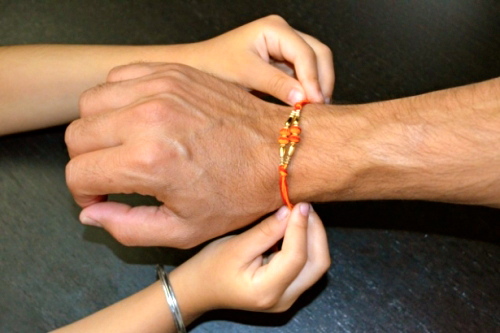
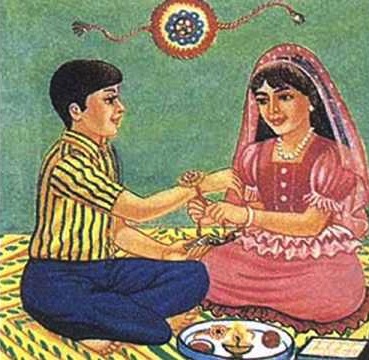
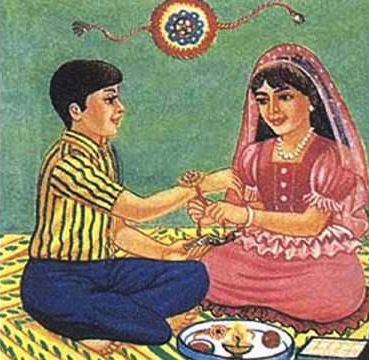
Raksha Bandhan is a Hindu festival that celebrates the duty between brothers and sisters. In Sanskrit, the word "Raksha Bandhan" literally means, "the tie or knot of protection." It symbolizes the protection a brother is to provide for his sister. On this day, a sister will tie a rakhri (sacred thread) on her brother's wrist. It's supposed to symbolize her love and prayers for his well being and the brother's lifelong vow to protect her.
I find this to be problematic for several reasons:
- I don't need to be protected by a man. I'm physically stronger than my brother. Plus I've practiced Tae Kwon Do for years. So, I should probably be the one protecting him. Furthermore, the Gurus gave Singhs and Kaurs equality, and gave me the right to protect and defend myself. That's why Guru Gobind Singh Ji gave me a kirpan, not a rakhri.
- Isn't love two-ways? Why doesn't the brother tie the rakhri on his sister's wrist too? Doesn't he love her? Or does love and prayer for good health only go one way? The love between my brother and me is a two way street. As it is with all of my siblings. Guru Ji taught us to love all of creation, not just the male ones.
- My love is stronger than a thread. My love for my brother and his love for me is stronger than a thread. Everyday we act in a way that exemplifies this love. Our consistent actions speak louder than a thread that will eventually fall off. A mere thread can't prove the love between a brother and sister.
- What if I have no siblings? Are the women who have no brothers doomed to a life without protection? Who will protect them? What about the men who have no sisters? Who will pray for their wellbeing? Will they die a pre-mature death?
- It's counter-Sikh: Ultimately, the rakhri is demeaning to women. It propagates the second-class citizen idea of women and thus, it's counter to the Sikh philosophy elevating women. Furthermore, it's superstitious and undermine's the Guru's teachings of rejecting rituals.
- What about my sister? I want to show my love to my sister too, not just my brother.
"Nowhere in Sikh history is any Sikh Guru known to have accepted this Hindu custom," said Lakhvir Singh on his blog. Often one hears about a painting depicting Bibi Nanaki tying a rakhri on her brother, Guru Nanak Sahib; this is nothing more than a work of fiction, the result of an artist taking too much artistic license, and is not substantiated by historical evidence.
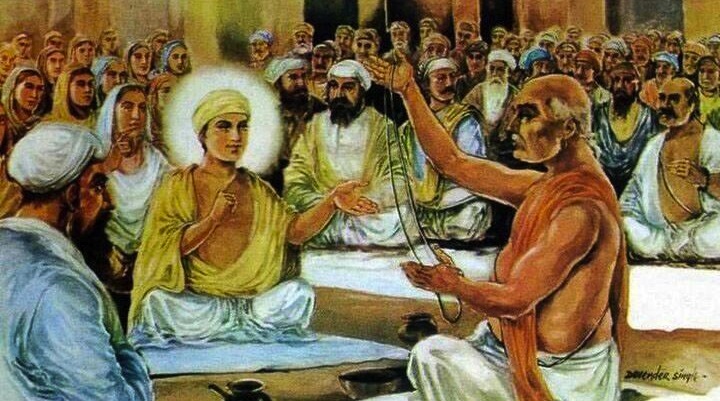
Singh points out that from the very beginning, Guru Nanak rejected the janeu (the Brahmins' spiritual thread) which Hindus believed connected them to God. He rejected it in front of all the Pandits, Brahmins, and his own father. Would that same Guru accept the far more earthy thread of the rakhri? I don't think so.
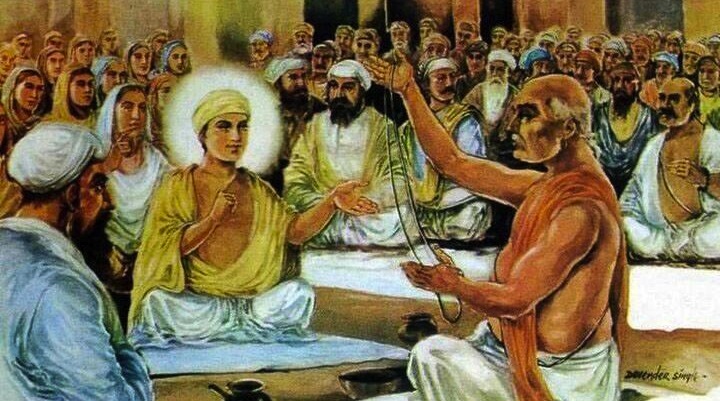
Guru Nanak rejecting the janeu
When I was about ten, my cousins asked me to tie rakhris on their wrists. I immediately had images of Guru Nanak rejecting the janeu, so I refused to tie the rakhris. My mother got mad at me and pulled me aside, telling me, "Just go along with it!"
She would often argue, "There's no harm in celebrating it! It's just expressing love!" Though that may be true, the rakhri is not in line with our Guru's teachings. One of the hallmarks of Sikhi is the shedding of meaningless rituals, practices, and festivals. The Gurus worked hard to establish this and when Hindu elements crept into Gurdwaras in the 1800s, the Singh Sabha Movement worked to get rid of them. Now, we voluntarily embrace the Hindu ritual of rakhri without thinking of the history or the consequences. Such acts take us away from Sikh Rehat and dilute our essence.
"Festivals and ceremonies like rakhsha bandhan are for those whom for it was made. Within the Hindu faith it has it’s own valid reasons," writes Lakhvir Singh. "Sikhi has its own distinct philosophy and moral compass...Guru Nanak did not accept the janeu; he rejected the offering of water to his ancestors; he did not recite the Hindu Vedas; nor prayed to the 330 million Gods. He only contemplated on the shabad that was revealed to him from the divine. Likewise, the other Sikh Gurus further developed what Guru Nanak preached; they never contradicted Nanak’s message and way of life.
While the ceremony is a beautiful one, it simply has no place in Sikhi...The simple thread that is meant as a prayer to protect a sister and to seek the blessings of the brother’s long life and well being, should not trump the belief that it is actually Akaal Purakh who protects and blesses us."
If you really want to celebrate a holiday and bring your family together, why not celebrate Sikh holidays like Gurpurabs, Dastar Bandi (first tying of the turban), or Charni Lagna (the commencement of reading the Guru Granth Sahib)? Or establish your own traditions! For example, you could honor Mai Bhago with an annual hike, horse ride, or a picnic!
I think it's okay to celebrate other cultures' holidays as long as these holidays are not in direct opposition to our Sikh beliefs.
- Title
- Don't Need a Rakhri, I Have a Kirpan
- Subject
- en Bana and Saroop
- en Equality
- en Gender
- en Guru Nanak Sahib
- en Gurus
- en Interfaith
- en Culture and Tradition
- en Identity
- en Janeu
- en Holidays
- en Patriarchy
- en Self Care
- See all items with this valueSocial justice--Religious aspects--Sikhism
- Description
- A Kaur reflects on how a common tradition that Sikhs follow opposes Sikh beliefs and encourages others to reconsider celebrating this tradition.
- Author
- Anonymous
- Date
- 8/11/2014
- Comments
-
HK on August 11, 2014 at 11:15 PM
I'm glad you stood up to your Mom and refused. I never could. Somehow I didn't have the courage. I'm gathering the shreds of courage where I can and reading about you has added another shred, and I'm grateful. But even now, I use the day as an excuse to reach out to my cousins on FB. Your post made me realize that it's time to reach out to my girl cousins too. As they say, Chardi Kala.
Kaur Life on August 12, 2014 at 11:10 AM
Gur Fateh Harleen! I'll be sure to pass on your message to the author. Standing up to culture that you don't agree with is difficult and is a life long journey. Hang in there! Chardi Kala!
Baljeet Kaur on August 12, 2014 at 5:09 PM
i believe the purpose of any religion is to bring an individual closer to the divine (god, the true self, Nature, the Universe, whatever you may call that connection). you have to ask yourself if what you are doing is taking you closer to that connection, taking you further away, or if it is simply irrelevant. i don't think rakhri in any way can bring an individual closer to god, but i also don't think it will take you further away from that connection either. it's simply irrelevant - as irrelevant as watching your favorite movie or brushing your teeth are to your journey towards god. these may be fun (or even necessary, like brushing your teeth because nobody likes smelly breath) parts of your life which may not add to your connection, but, in my opinion, they certainly do not take anything away either. i believe it is divisive to draw lines between what is "hindu" and what is "sikh" or "christian" or "muslim." this results in our placing more importance on the titles of the religions themselves and less on the message of each - universal brother/sisterhood and union with the divine. culture is irrelevant. if you personally feel a holiday like rakhri takes away from your autonomy or renders you subordinate, then by all means, do not partake in it. some people may feel that way, and others may not. these things are individual and subjective. but do not confuse culture with religion, and do not place more importance on the title forget about the core message.
N Kaur on August 13, 2014 at 4:10 PM
"i believe it is divisive to draw lines between what is “hindu” and what is “sikh” or “christian” or “muslim.” this results in our placing more importance on the titles of the religions themselves and less on the message of each – universal brother/sisterhood and union with the divine. culture is irrelevant." Could not agree more! I tie rakhris on my male cousins and brother every year. It is a cultural tradition in my family and it brings us together (as do many other holidays) to spend some time away from our busy isolated lives. This tradition is irrelevant to my journey towards the divine as a Sikh. It is simply an age old tradition that brings about laughter between us siblings. Nothing less and nothing more. Every cultural tradition or practice, i believe has a different meaning for each individual. I do not feel degraded as a woman by this tradition because I know the thread does not hold any sacred power that would "protect" me. Divisive lines set between religions is not what my Sikhi is about.
Gurvinder Singh on August 13, 2014 at 11:47 PM
Oh absolutely.. what a beautiful thought process.. then I wonder why Guru Nanak Sahib rejected the janeu (it was simply a thread and showcasing commitment and didn't lesson Guru Sahibs stature).. why did Guru Sahib create a different faith with its own principles, scripture and character?
After all its divisive to draw lines between Muslims/Hindus/Christians..
Why did the sahibzadas sacrifice themselves? They should have just stated they accept Islam, after all isn't it divisive to draw lines between Islam/Christianity/Hinduism? I mean just saying something doesn't deviate you from your path to the divine..
Basically quit hiding behind a facade and admit that you don't have the gall to stand up to a meaningless charade of a day that upholds tenets which are polar opposite of Sikh philosophy.. don't cloak it under the grandiose verbose of humanity..
N Kaur on August 14, 2014 at 1:48 PM
To Gurvinder Veerji:
All the sacrifices made by our gurus were to oppose OPPRESSION. The gurus did not "create" a "separate religion", they followed and encouraged others to follow a life of truth and love for all of humanity. They stood up in the face of oppression, gave their lives to protect the rights of PEOPLE as people. Guru Tegh Bahadur sacrificed himself to protect the personal religious beliefs of the Kashmiri Pandits and all others being compelled to convert. The chote sahibzades sacrificed themselves to oppose the Islamic regime. They protected the righteous beliefs of ALL people, regardless of what those beliefs were. The Sikh philosophy and belief in humanity are not mutually exclusive.
Gurvinder Singh on August 16, 2014 at 8:58 PM
Bhenji.. you have placed an argument which is diametrically opposite of itself.. The sikh gurus didn't initiate a separate faith? - from where you base that I would love to hear as history and gurbani tell a very different tale.. By the way what are signifying signs of a religion or faith?
And why oppose any regime for there is no difference between a sikh and Muslim and Hindu so it doesn't matter if you convert or not correct? For they are merely labels..
Our belief system is to serve the creator through his creation but it is a distinct and independent system.. to say otherwise is to ridicule our history, our gurus and our shaheeds.. so I request you to choose your words carefully..
You may choose any label for yourself but as for myself, I will go with Sikh..
Gurpreet on December 5, 2014 at 11:21 PM
This is my understanding so far: Truth is the religion. The term sikh means to be a learner. The Guru's taught how to follow the path of Truth. Doing so would make you a Sikh of the Guru. Here are some shabads to reflect upon " gur kee seva shabad weechar". "Dittya mukt nah hovee jichaar shabad na karay weechar" . Also " phasan kee bid sabh ko janaaa shooten ki eik koi"
Simi on December 6, 2014 at 3:28 PM
Neither Hindu nor Sikh, I find the divisive tone of this post really rather sad. Yes you should celebrate your heritage but if there's something beautiful in a different heritage, why shun it thus and chastise others who do see the beauty in it? And yes there's something especially beautiful about the celebration of a platonic relationship as in Rakshabandhan. It is in all respects not a male-chauvinistic tradition except if you really want to find flaws with it and see it that way. Both parties give each other wishes of love protection and safety. The history of Rakshabandhan is fascinating. Used as a way to cause truce in war, and a symbol of platonic friendship, it's not a message of religion at all. It's one of those non-religious holidays that can be celebrated by anyone. Like Thanksgiving in the US. Now whether you want to find beauty in it or use it as a way to divide yourself is really up to you. But as a non-Hindu, I enjoy the concept and will continue to send rakshabandhan wishes.
- Item sets
- Community