
A Response to the Unconventional Anand Karaj
History is Not a Homogenous Tale: A Take on the Unconventional Anand Karaj
by Baghael Kaur
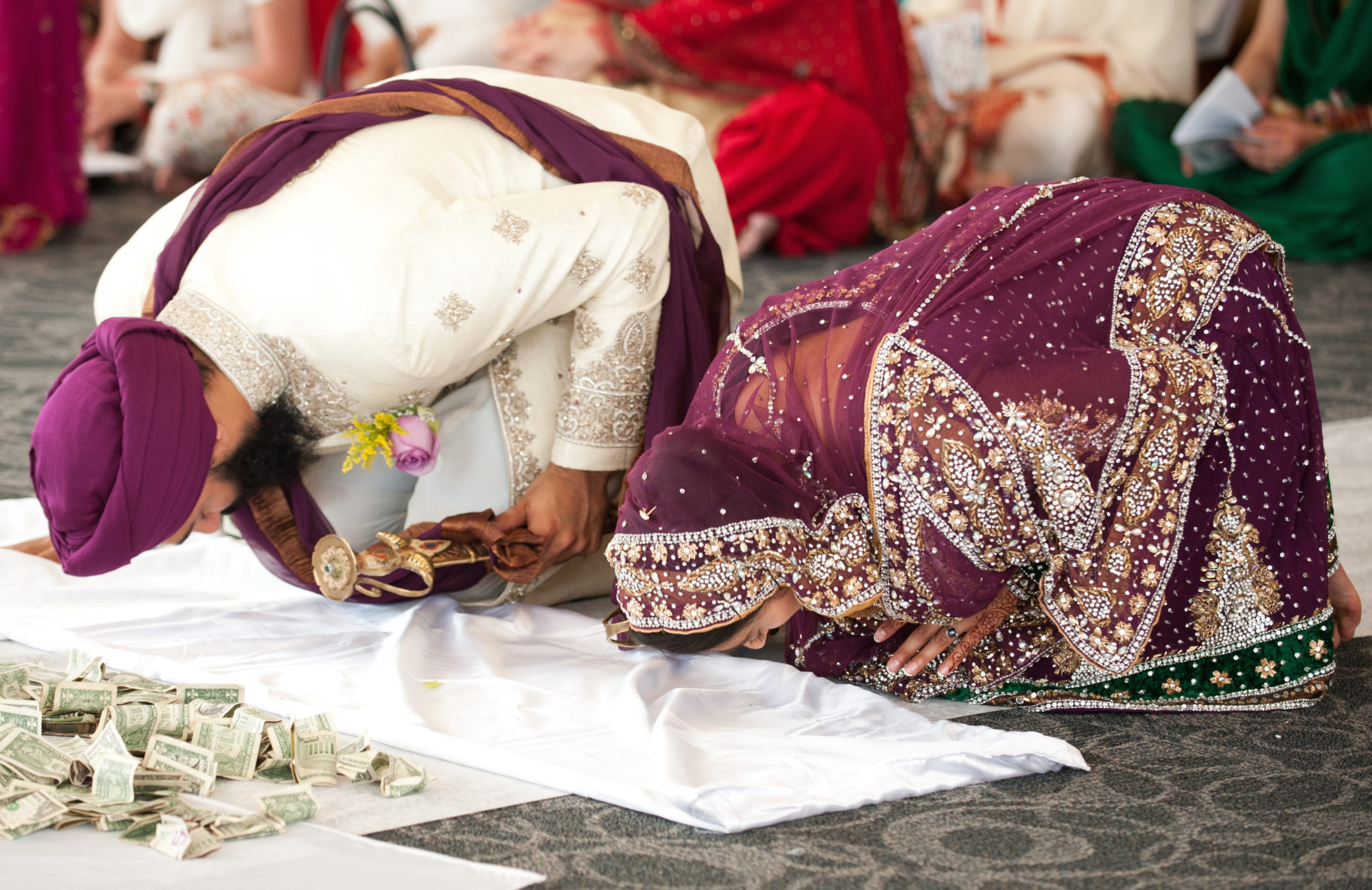
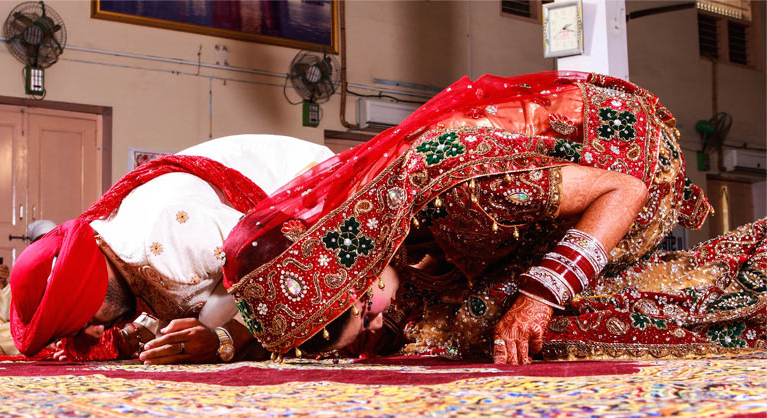
We cannot take for granted that the ceremonies which we participate in as Sikhs, as we know them today, are perfect replicas of what Guru Sahib created for us. In fact, any study of history would support the strong possibility (in the absence of eye witness accounts from the time, a hukam issued by Guru Sahib regarding the ceremony, references in Gurbani, etc) that such ceremonies are not perfect replicas, but are products of the interface between (mainly) Panjabi culture and Sikhi.
I think that it's popular to imagine history as a monolithic and homogenous tale, one that naturally becomes more 'conservative' and 'authentic' the further back you go, and more 'deviant' as one moves towards the future - yet, I myself have heard stories of couples from the 1950s who sat during the Lavaan in order to prevent bringing undue attention to themselves, and to ensure that the Sangat remained focused on Guru Granth Sahib Ji (and one couple in particular is highly regarded within the panth).
Religious history moves like waves, greater diversity of practices meeting periods of solidification and codification (see: Singh Sabha movement). I am not placing a judgement on these waves - whatever way they go - all is Guru's hukam. And I share similar concerns with others that it often seems that Guru Granth Sahib Ji is not respected as the centre of the Anand Karaj ceremony, and that we must be very humble when considering alterations, for fear of genuinely going against Hukam.
However, I'm a little suspicious of the level of outrage and shock in response to the decision this couple made to walk side by side during the Lavaan - especially when we all know that there are MASSES of things that happen before, during and after the Anand Karaj that are in fact clearly against Sikhi, or are done for reasons that may not be against Sikhi but that's only because we don't actually know WHY they're done (i.e. why is oil applied to door frames before the bride comes home?). In fact, if we don't know why we're doing something, isn't that inherently against the teachings of Guru Sahib, who admonishes us to reject empty ritualism?
It seems like we're ok with adjustments - in one generation we've seen the introduction of bridesmaids and flower girls - but when an adjustment comes along that seeks to challenge gender inequality, then suddenly it's against Sikhi?
Essentially, if tradition means 'from Guru Sahib Ji' - then clearly, no alteration must be made. If, however, tradition means - the development of a ceremony or way of doing something which emerged after Guru Gobind Singh Ji's time, the practice of which is unverifiable as emerging from Hukam, then perhaps a discussion is due when such practices seem to replicate and support social injustices.
- Title
- A Response to the Unconventional Anand Karaj
- Subject
- en Anand Karaj
- en Bagael Kaur
- en History
- en Marriage
- en Relationships
- See all items with this valueSikh marriage customs and rites
- Description
- Baghael Kaur responds to the outrage and shock that resulted after Kaur Life shared Shawn Singh Tucker and Baljit “Bally” Kaur Lehal's decision to do an unconventional Anand Karaj.
- Author
- Baghael Kaur
- Date
- 12/9/2014
- Comments
-
I Singh on December 10, 2014 at 2:26 AM
Fair argument.....is there a proof that the current anand karaj ceremony came after guru sahib and how it got initiated? Even if it did come after, are we willing to be egoistic enough to say that our understanding of sikhi is way higher than the puratan gursikhs who might have formalized this ceremony. Most of rehatnamas and even dasam bani (let's just focus on nitnem banis for now) were written or compiled after guru sahibs.
These guys who got married clearly don't follow a lot of rehats which are well established. What right do they have to start challenging things when they clearly don't follow basic hukams themselves. Jewelry/makeup definitely came after guru sahib, are they going to give up that too. It's unfair to pick and choose what works for
Bottom line is even their reasoning for doing this was based on haume. They wanted to be different so they get recognized. Gurmat or its correct interpretation wasn't ever the criteria for doing this.
I Singh on December 10, 2014 at 2:33 AM
My point.... people don't show the same interest and enthusiasm in following basic well established hukams and rehats, that they do in challenging what "they feel" doesn't work for them or their smart mind tells them doesn't make sense. Far far away from real essence of Gurmat.
Singh on December 10, 2014 at 2:55 PM
I agree with you!
Most of the couples now a days try to do something different on their wedding to make it something unique. And they wanted attention and they got it, Just like any hollywood or bollywood celebrity. If you start challenging Sikh Rehat Maryad, then where do you draw the line. And it wasn't drafted by some anti panthic crook overnight but took almost 13 years to develop with a lot of input from Sikh scholars, historians, organizations and it did include women. There might be some flaws in it but this is not the way to challenge it. ONLY panth and Sarbat Khalsa can amend it or change it! Otherwise everyone will start challenging it and this is not the time for it. We already have enough attacks from RSS, deras and other anti panthic organizations and the least we need is attacks on our maryada from our "wise" youth. Your love for your Guru is personal but when it involves "Maryada" it is not personal but panthic. Please stop ruining the sancity of the only document panth has created after a lot of Struggle during Gurudwara Reform movement and Singh Sabha Movement to unite Sikhs.
Amrit on December 10, 2014 at 8:11 PM
This website seems to be run by many females who seem to be going out of their way to prove that they are equal to men. Personally, I've grown up being taught that behind every man there is a woman. Your Guru has told you and proven over and over again how that as a woman, you are just as equal to a man, so why in the world would you need to do something like walking side by side with the groom?Anand Karaj is about being one with God and not showing people you are equal, and how would it prove that you are equal when one is further than the other from Guru Maharaj?
Yes the rituals that are done before and after the Anand Karaj are not part of sikhi, and that's because we've fallen into incorporating other cultural and religious ways. And that's a huge thing as well, however, there are so many sikh weddings that happen that don't have these pointless rituals. People only continue to do the useless & unrelated rituals because they are uneducated.
As our Guru's children, we need to help each other understand why certain things shouldn't be done.
I Singh on December 10, 2014 at 10:23 PM
Good Point Veerji!!!
ONLY panth and Sarbat Khalsa can amend or change a maryada. End of the Story.
Baghael Kaur on December 10, 2014 at 11:41 PM
Waheguru ji ka khalsa! Waheguru ji ki fateh!
I appreciate you sharing your thoughts here.
Aside from second hand sources, I have to admit that I have limited knowledge of the history of the anand karaj. My understanding to date is that this ceremony has undergone multiple changes throughout history, and that directly preceding the development of the current rehat maryada, there were many forms of the ceremony being used, hence the effort to create a more standard practice across the panth.
This is why I currently have no position on whether this couple's decision was 'right' or not. I hope that the historians in the panth can help us all in our understanding, so that we can make choices that truly reflect Guru Sahib's hukam for us.
That being said, I don't think the argument that previous Gursikhs did not make such an alteration, and therefore 'what right do we have' to make such a change, is a fair position. For one, there are infinite issues in the panth, and we cannot expect that Puratan Gursikhs would have been able to take a position, and action, on all these issues.
Secondly, if the anand karaj was practiced in many forms throughout history, then it wouldn't have even been possible for such Gursikhs to make a change, or to make comment - the diversity of practice would forestall such a reform.
Finally, even the most enlightened gursikh is human, and has limitations. Only Guru is without fault. We cannot use our deep respect and love for such Gursikhs as a reason to not engage fully with the issues in the panth, to the best of our ability and in utter humility.
Baghael Kaur on December 10, 2014 at 11:43 PM
Vaheguru ji ka khalsa! Vaheguru ji ki fateh!
I appreciate you sharing your thoughts here.
Aside from second hand sources, I have to admit that I have limited knowledge of the history of the anand karaj. My understanding to date is that this ceremony has undergone multiple changes throughout history, and that directly preceding the development of the current rehat maryada, there were many forms of the ceremony being used, hence the effort to create a more standard practice across the panth.
This is why I currently have no position on whether this couple’s decision was ‘right’ or not. I hope that the historians in the panth can help us all in our understanding, so that we can make choices that truly reflect Guru Sahib’s hukam for us.
That being said, I don’t think the argument that previous Gursikhs did not make such an alteration, and therefore ‘what right do we have’ to make such a change, is a fair position. For one, there are infinite issues in the panth, and we cannot expect that Puratan Gursikhs would have been able to take a position, and action, on all these issues.
Secondly, if the anand karaj was practiced in many forms throughout history, then it wouldn’t have even been possible for such Gursikhs to make a change, or to make comment – the diversity of practice would forestall such a reform.
Finally, even the most enlightened gursikh is human, and has limitations. Only Guru is without fault. We cannot use our deep respect and love for such Gursikhs as a reason to not engage fully with the issues in the panth, to the best of our ability and in utter humility.
I Singh on December 11, 2014 at 5:08 PM
I can agree with your position that lot of issues in the panth are up for debate and can/should be discussed but if a maryada is to be revisited or changed that decision lies with the Akal Takht/Sarbat Khalsa(Panth).
We as individuals can definitely discuss about issues but do not have the authority to make changes as per our own wishes. Panth takes a stand and we as Sikhs follow it. This has been the case throughout our history.
Prabhu Singh on December 11, 2014 at 6:02 PM
It's fun to judge others, until one day the same judgement comes to bite us. Right and wrong are always relative. When you judge another person or people's actions as haumay without being antarjaami, is that haumay as well? Which "offense" is greater, after all haumay is haumay, can there really be degrees of it?
Also, jewelry most certainly did not come after the Guru's time, that's ridiculous.
Guru Gobind Singh was totally decorated consistently and recognized as King of this world and the next.
If we are to be recognized as Guru Ji's children, as he instructed for us, shouldn't we make some effort to convey the regal presence of our master?
Traditions on December 12, 2014 at 12:47 AM
it's unfair to say this couple wanted attention. In fact this is something I myself have wanted to do for as long as I can remember because it's important to me that I walk beside my husband with only God to guide us. I never considered the amount of attention it would get from anyone at the ceremony, let alone people on the outside looking in. It's as important to consider personal beliefs as it is religious ones and how they can work in unison. If the lavan have been done differently many times in the past, why are they suddenly just seeking attention by doing it differently? This is their interpretation and they made a choice to get married with God's presence, in god's house. That on it's own is a show of respect and the fact they they do believe in putting God first. Who are we to judge what was in their hearts?
I agree with the author, as a society we seem to find it much easier to accept changes to other aspects of the wedding ceremony but not when it comes to changing gender roles. Why is it okay for a flower girl to drop petals as she walks or for some couples to decorate the Gurdwara? They are adding new traditions for aesthetic reasons and we ignore that because its nonthreatening. We do the same thing in our daily lives and take offence when women are viewed as equals. Often the uproar comes from those who do not understand why a person would have differing beliefs than themselves, or those who stand to lose a position of power or privilege.
Religion is often influenced by culture, as the culture changes, so will the physical elements of the religion, little by little, over time.. That doesn't mean a person is respecting God any less, it means they are respecting God in their own way, allowing all of their beliefs to live in harmony within themselves.
If you ask many different people of the older generation why things are done a certain way, they will not give you the same response. Everything is interpreted differently but that's not to say anyone is any less respectful or deserving of respect in their choices.
Traditions on December 12, 2014 at 12:53 AM
Please elaborate on why you feel the physical distance from the Guru Granth Sahib would prove to be an inequality when God is omnipresent.
Also, why do you feel it is acceptable for "uneducated" people to do "useless and unrelated rituals" when it comes to other aspects of the wedding ceremony, but are unforgiving towards a couple walking side by side?
Part of the point here is that we brush off these other useless and unrelated rituals as no big deal but everyone is up in arms about this. Why is this one thing such a big deal when nothing before it seems to have been?
Bhupinder on December 12, 2014 at 7:42 AM
In response to your question why is oil applied to door frames before the bride comes home? According to my (late) Punjabi professor, the doors of the family home in India would be left creaking and unoiled for a long time. For many, oil was an expensive luxury at the time. During a marriage, with many guests attending from afar and all going in and out of the family home during the festivities, oil was poured on the doors to grease them. It's a practical reason really, like many of these rituals which have lost their real meaning. And by the way, oil is not just poured when the bride and her family arrive, it's also done when certain family members arrive, especially those from afar.
Baghael Kaur on December 12, 2014 at 2:21 PM
Vaheguru ji ka khalsa! Vaheguru ji ki fateh!
Fascinating! I think that this is a perfect example of how so many traditions begin - from a practical root. The danger is when we forget why they are done, often because the practical need is gone, and then we continue doing them from a sense of superstition, i.e. that we will be unlucky or that Vaheguru will not bless us if we do not do this thing, or that others will think bad of us if we do not do it.
I think we also do these things from a sense of nostalgia - we associate them with our childhood, with our parents, and we do them in the service of that warm, safe, celebratory feeling that we felt as kids.
We also conflate these traditions with honouring our elders - with giving some of the love back which we have received, by replicating what we have seen them do.
From my own life, I can totally understand why it would be hard to change or give up these things. The first step, I think, is to be aware, and to not invest such things with more meaning then they deserve.
This is not an easy issue, and I come at it from a very privileged position - not being Panjabi (and having a husband and extended family who themselves reject what they see as Panjabi cultural rituals) means that it's easy for me to remain unattached to those things which I have identified as non-Sikh rituals. Nonetheless, I appreciate being able to share my perspective here.
I Singh on December 12, 2014 at 4:00 PM
It is none of my business what someone does in their private life but this instance was different in that, this affected the maryada which belongs to the whole Panth, so I chose to respond.
I judge no one for their personal actions but I have every right to respond if someone decides to do something that goes against the panth and so should every Sikh.
Read my other comments, I believe in an individuals right to hold an opinion but authority to change rehat and maryada belongs to the panth only.
BTW, you know what is funny. You too just totally judged me bro.
Off topic though, We all suffer from Haume, so do I and thanks for pointing that out. Everything we do in our daily life stems from it including this back and forth bickering we do. In hindsight, I shouldn't even have posted anything here. LOL
And yes, there are different degrees of Haume. I don't have time to get into those details. Every Vikaar(Evil) has different intensities and degrees of it and everyone suffers from them, some less/some more.
Stay Chardi Kala my friend!!!!
surinder singh on December 13, 2014 at 2:23 AM
I happened to read and article which is pasted below, hope this will throw some light on the subject:
The Anand Marriage Act
K. S. TALWAR
National Archives, New Delhi
Recently some attempts have been made to suggest that the Anand marriage ceremony was initiated by the Namdhari Guru Baba Ram Singh. Both Dr. Fauja Singh Bajwa and Dr. M. M. Ahluwalia in their works on the Kukas contend that the Namdhari Guru was the initiator of this form of marriage. Dr. Ahluwalia has even written that “The Namdhari sources claim that the Anand Marriages were not initiated by anybody except their Guru Ram Singh” and also that “the Anand Marriage Act was passed by the Government of India due to the efforts of the then Namdhari Satguru Pratap Singh, Tikka Ripudaman Singh of Nabha and some others.”1 A study of the papers relating to the Act does not support this sweeping contention. True, the Kuka Guru did send a letter to the Government to support the measure.2 But in this he was acting in concert with several other Sikh leaders and associations. In fact, neither he nor his followers claimed the Anand marriage to be their innovation.
The Anand ceremony “was initiated by the third Guru of the Sikhs, Guru Amar Das and the marriages of Bhai Kamlia and Matho Murari were performed in accordance therewith in the time of third and fourth Gurus, the last of whom composed the four Laawaan in the Suhi Rag of the Guru Granth Sahib, the sacred book of the Sikhs.”3 The occasion and circumstances for the initiation of this form of marriage has been detailed in a note prepared by [?] the then professor of the Khalsa College, Lyallpur. He wrote:
Guru Amar Dass tried to barter down all the injurious caste barriers, and, incensed at this noble effort of the third Guru, the Hindus excommunicated those Sikhs of the Guru who in obedience to his teachings had ceased to observe caste. Among those Sikhs was one named Randhawa. When he wanted to marry his daughter, the Brahmins refused to come and officiate at the solemnisation of the marriage, saying that having become a Sikh of Guru Amar Das he had ceased to be a Hindu, and thus had forfeited every right to have the marriage of his daughter performed according to Hindu rituals. Upon this the Sikh went to Guru Amar Das Ji, and said he was prepared to keep his daughter unmarried, but would on no account consent to the ceremony being performed according to Hindus who were so wrath at his having given up the whimsical caste distinctions. Realizing the fix in which the Sikh was, the Guru ordered his son-in-law (afterwards Guru Ram Das Ji) to go and officiate at the marriage of the Sikh’s daughter. It was on this occasion that the four laawaan were originally composed by the fourth Guru.
The next noteworthy occasion on which the entire form prescribed conjointly by the third and fourth Gurus was observed was the marriage of the sixth. Guru’s daughter (Bibi Viro) at the village Jhabal in the Amritsar district.4
Henceforth a fair came to be held annually to commemorate this remarkable marriage. Ever since that day the Anand riti became the recognised form of marriage among the Sikhs.
This ceremony however fell into partial disuse soon after the Sikh power was established in the Punjab. Earlier and so long as they had no settled home, “the Sikhs united by the bonds of common faith lived a free untrammelled, selfless life, acknowledging no leaders, ordaining no priests and acting independently of each other, yet ready to share the weal and woe of a brother Sikh. Occasionally they met in a general council called Gurmata to decide matters of common interest and of an importance which required united action. They led plain simple lives as members of a single household, sharing whatever they had and owing obedience to none, performing their own marriages and reciting hymns from the Granth when anyone passed to the land of Gurus.5 But soon after the founding of the Sikh power in the Punjab, “the republican fraternity broke up, strong men asserted themselves as leaders and surrounded themselves with power, wealth and luxuries of life, and the Sikh settled down in a population of Hindus. Scattered and small in number they could not resist the influence of Hinduism, which gradually asserted itself till all but in dress they became identified with the Hindus. They began to observe all Hindu customs, all Hindu ceremonies, to which recitation from the Granth were sometimes superadded.”6 The influence of the Dogras in the employ of Maharaja Ranjit Singh, in this process of degeneration of the Sikhs, was no less great and even “the idol worship, the practice most vigorously denounced by the Gurus, found its way into the Darbar Sahib at Amritsar.”7
Yet, the Anand ceremony escaped absolute obliteration as a result of widow marriages because these were not recognized by Hindu Law. It also remained in vogue among the Nihangs, Bandeis (adherents of Banda Singh Bahadur) and Sikh residents of far off places from the Punjab like Nander and Patna.
The first serious attempt at the revival of the Anand marriage ceremony was made during the time of Ranjit Singh by Baba Dyal, founder of the Nirankari movement. This ceremony as propagated by him apparently consisted of the bride and bride-groom walking round Guru Granth Sahib while the Granthi read out certain sacred scriptures from the text.8
The second attempt was made by the Namdhari Guru Baba Ram Singh who also adopted the Anand ceremony, but with a major difference. Whereas the Nirankaris performed their marriages without the sacred fire and without the interposition of Brahmans, the Kukas continued to dig, like the Hindus sacrificial pit for burning fire and put fragrant substances into it at the time of their marriages.
The third and the most important attempt at the widespread propagation of the Anand form of marriage was made by the Singh Sabha movement. The marriage ceremony as propagated by the Singh Sabha resembled the Nirankari rather than the Namdhari version of the Anand marriage. The chief requisites of this form of marriage were:
1. The presence of Guru Granth Sahib, the Sikh scripture, on the occasion of marriage to serve as witness, dispensing with the burning of fire and the invocation of gods marked out on ground with flour in symbolic figures.
2. Citation of four Shabads (hymns), known as laawaan from the said scripture to solemnize the tie of union between the bride and the bridegroom after they are questioned as to their willingness to enter into the sacred union. The couple, in token of solemn pledge before and homage to the scripture, walks around it when each of the said four hymns is read, thus doing four rounds in all.
3. The singing in chorus of the hymns which after the word Anand (pleasure) with which the hymn begin are called Anand Sahib. In these hymns thanks of Almighty accompanied with joys are expressed for having gained the desired object and one is instructed to look to Him for every success and pleasure.
4. The reading out of Ardas (prayer) invoking the benediction of the Ten Gurus and of the sacred scripture to grace the union which is declared complete after a sermon is delivered as to the respective duties and responsibilities of the couple enjoining on the bride to be always submissive to her husband who in return is bound to have every regard for her feelings and to think always of her convenience and pleasure in preference to his own keeping thereby the balance of perfect harmony and happiness of home.9
This form of the Anand ceremony even to this day continues to be performed at the Sikh marriages, in the presence of the bride, the bridegroom, their relatives, friends, etc., and is conducted by a religious person known to be well versed in Sikh tenets, and sacred hymns are also sung to add grandeur to the occasion.
For the proper understanding of the genesis of the Anand Marriage Act, it is worthwhile here to describe briefly some of the major effects of the Singh Sabha movement in this regard. Launched during the last quarter of the nineteenth century to restore Sikhism to its pristine purity, this reform movement caused a schism in the Sikh community by dividing it into the ‘puritans’ or ‘reformist’ who observed all the ordinances of the Gurus, and the ‘degenerates’, as they were called by the reformists, having leanings towards Hinduism. The ‘puritans’ regarded themselves as the true sons of the Khalsa and the Granth Sahib as containing the whole law. Discarding the old Hindu customs, they started performing their birth, marriage and death ceremonies in the old simple Sikh fashion. The ‘degenerates’ or the Hinduised Sikhs-an important section of the Sikh community, although a small minority—on the other hand, practised mostly the observances of Brahmanical religion and were Sikhs only in name.
At a time when Sikhism was fast sinking into the fold of Hindu religion, this reform movement led to the emergence of numerous Singh Sabhas all over the country and the despatch of missionaries by the Chief Khalsa Diwan. The result of this was that, unlike other reform movements, the Singh Sabha movement did not remain confined to educated few, but touched the Sikh people in general. Soon there was a feeling that they were not Hindus and so desired to have a body of laws of their own, laws of marriage, inheritance and succession based on social justice and equal rights for men and women, free from all taint of inequality and compulsion, worthy of a free God-fearing Sikh community.”10 This was greatly resented by those who preferred Brahmanical customs and by the Brahman priests who viewed with displeasure the loss of so large a clientele as that represented by Sikh population. In the heat of the religious controversies that ensued the opponents of the ‘puritan’ even questioned the validity of the Sikh customs. Their bitterest attacks were, however, on the Anand marriage ceremony.
It was against this background and in an atmosphere of tension and uncertainty in the first decade of the present century that Tikka Ripudaman Singh of Nabha, Member of the Imperial Legislative Council, thought of statutory recognition for the Sikh marriages to dispel doubts as to their validity. With this end in view Tikka Sahib held discussions with the Law Member of the Viceroy’s Council, Sir Erie Richards, at Simla, and afterwards wrote to him that “nearly all leading Sikhs badly feel the want of codifying their laws, and also think that the proposed Sikh Marriage Act will be the first and most appropriate step in that direction.” In support of his contention, he forwarded the opinions of ninety-three leading members of the Sikh community. He also sent a draft bill of the proposed legislation and, urging for its adoption, wrote that there were “good reasons to believe that, in the absence of a validating enactment, doubts may be thrown upon it and Sikhs may have to face great difficulties in the future, and incur heavy expenditure on suits instituted in the Civil Courts.” He also wrote that the passing of this enactment involved no new principles but merely validated an existing rite.11
Tikka Sahib’s letter along with the draft bill was referred to the Home Department which, in turn, sent it to the Government of the Punjab for an opinion on the subject. The first reaction of the provincial Government was not in favour of the bill and it wrote back that “in the absence of any established necessity for legislation, the Lieutenant Governor, would be adverse to the adoption of any such action” but suggested that “the real object of the proposed legislation” should be ascertained from the Tikka Sahib personally.12
Sir Louis Dane, the succeeding Lieutenant-Governor of the Punjab, was therefore asked to discuss the question with Tikka Sahib. After meeting Tikka Sahib and making necessary enquiries from other sources, the Lieutenant-Governor felt “inclined to take somewhat different view of the proposed legislation, from that put forward by his predecessor.” The Chief Secretary to the Government of the Punjab further wrote that “the Lieutenant-Governor has satisfied himself that the Anand form of marriage has been impugned by non-Sikhs and more especially by the members of the Arya Samaj, and that there has been a certain amount of pamphlet welfare in which the children of such marriages have been branded as illegitimate by the opponents of the Neo-Sikh party,”13 Even though, there had yet been no case where the validity of such marriage was contested in a law court, the Lieutenant-Governor recognized the force of Tikka Sahib’s argument that “the object of the proposed legislation is to avoid the uncertainty and the expense which the process of obtaining a judicial decision would entail.” Moreover since the ceremony was “a simple and less expensive one than that ordinarily in force among Hindus,” it was also suggested that the proposed bill be “introduced in the Imperial Legislative Council as it was to apply to the whole of British India.”14
The Bill was introduced in the Imperial Legislative Council meeting at Simla on 30 October, 1908. It was widely acclaimed by the Sikhs. That the Bill had the popular support of the community was evinced by the numerous communications received by the Government in favour of it. Still there was a small section of the Sikhs who published pamphlets and sent representations to the Government demanding the withdrawal of the Bill.15 Since it happened to be an important segment of the community, their viewpoint should be examined.
It was contended that the supporters and sympathisers of the Bill did not represent the main body of the Khalsa; and the support that the Bill had received was the product of an agitation and not the outcome of the genuine feelings of the Sikhs.
They further argued that ‘Anand’ signified pleasure or joy, and it was not a form of any marriage ceremony common among the Sikhs; that it was a prayer and name of a collection of certain sacred hymns in the Granth Sahib. They also claimed that though the Sikhs by strictly following the teachings of Guru Granth Sahib were distinct in their religious tenets from Hindus, in their social customs they were one with them having little desire to break away from the Hindu social or customary laws.
Finally, according to them, this was the creation of the Singh Sabha sect among the Sikhs, the members of which wished to establish new customs and ceremonies in accordance with the dictates of their new faith.
The supporters of the Bill took up these contentions and exposed their hollowness. They showed that ‘only bare hardihood’ produced and sustained by vested interests could claim general Sikh opposition to the measure. As against a total of five adverse communications to the Government, they referred to the hundreds of communications which included the opinions of the leaders of the Panth, the Sikh bodies, the Reises, Jagirdars, the Sikh Rajas and the general public both from inside and outside India, wherever the Sikhs were. In these circumstances only the wilfully blind could doubt the bona fides of the Sikhs in supporting the Bill.
The reformists claimed that the term ‘Anand’ also meant marriage contracted according to Sikh ceremony. Giani Gurbakhsh Singh, Manager of the Golden Temple Works. Amritsar, put forwards the following arguments in support of this claim of the reformists:
(a) Just as in Persian the word Shadi means both ‘joy’ and ‘marriage,’ so in Panjabi the word ‘Anand’ means both ‘joy’ and ‘marriage.’
(b) Sir Guru Das Banner ji had admitted in his Hindu Law that ‘Anand’ is the name of a marriage ceremony among the Sikhs. It is so called because during its performance a text from the Sikh scriptures called ‘Anand’ is recited.
(c) In Punjabi papers, 25 years old, we find notes on marriages performed according to Anand ceremony.
(d) In the Prem Sumarg and other Sikh books, the word ‘Anand’ has been used in the sense of ‘marriage’.16
Describing how essential it was for the Sikhs to solemnize their marriages according to Anand ceremony, Gurbaksh Singh further wrote:
Guru Granth Sahib strictly prohibits idol or element worship, but in the Hindu marriage ceremony the worship of nine constellations of the stars is necessary element and Agni (fire) is set up as witness god. So how can monotheists like Sikhs follow such customs? Again, our scriptures say! “do not pay any heed to the auspicious-ness or otherwise of the constellations; there is one God above all these;” but the Hindus have to wait for months and years for the auspiciousness to these occasions. Again, as a reward of conducting the marriage ceremony, the officiating Brahmin priest receives some money in charity; but our scriptures say: “Oh, priest, the jajman’s daughter is thy daughter. By accepting this money thou spoilest thy chance of salvation.”
Again, we find in a commentary on Shikh customs, “whoever accepts any reward for conducting marriage ceremony is an infidel.”17
That the Anand form of marriage was an old ceremony among the Sikhs and not an innovation of the reformists has been described above. The supporters of the Bill quoted several instances from Bhai Santokh Singh’s Suraj Prakash, then considered the oldest and the most authentic complete record of Sikh history, to show that this form of marriage was introduced by the third Guru. Since the Anand composed by the third Guru and the laawaan, i.e., ties composed by the fourth Guru, the sine qua non of the Anand ceremony, were embodied in the Sikh scriptures, the reformers put this forth as an irrefutable proof of the ceremony having been enjoined by the Gurus.
While the Government was still getting reports both for and against the Bill, an obstacle appeared in the way of carrying out the proposed legislation. Tikka Sahib’s term of office as a Member had expired and the Government on its part had allowed the introduction of this Bill on the clear understanding that it was not to take any part in the debates or voting on the Bill. However, the Government of India facilitated the measure by specially nominating Sardar Sunder Singh Majithia to the Legislative Council. The original draft of Tikka Sahib underwent some changes in the Select Committee and the Bill was passed on 22nd October as ‘Anand Marriage Act, 1909.’
These, then, were the circumstances that led to the passing of the Anand Marriage Act. As for the Kukas, whose role in this regard has been almost fabricated by recent writers, not only accepted it as a legalisation of “the ancient Sikh marriage rite,” but also felt unhappy about its final form.18 Obviously then, they were neither the initiators nor the main force behind the passage of this Act. The main bodies for the propagation of this form of marriage ceremony were the various Singh Sabhas, Khalsa Diwans and the Chief Khalsa Diwan, and the main force that carried the Bill through the Imperial Legislative Council were Tikka Ripudaman Singh of Nabha, Sardar Sunder Singh Majithia and the Sikh masses in general.
[Note—One of the prominent Sikh leaders who supported, through the press, the Anand Marriage Bill in 1909 was Bhagat Lakshman Singh. While the bill was on the anvil, awaiting passage through the Viceroy’s Council, the Arya Samajists of the Panjab and their friends raised a storm of agitation against it. It was at this time that Bhagat Lakshman Singh wrote a number of letters to the editors of the Tribune, Lahore, and the Khalsa Advocate, Amritsar. These letters, and those of Giani Gurbakhsh Singh, Bhai Lehna Singh and others addressed to the Government, greatly strengthened the hands of the Hon’ble Sardar Sunder Singh Majithia, the mover of the Bill, and facilitated its passage through the Council (vide the Tribune, Lahore, October 5, 7, 13 1909, and the Khalsa Advocate, Amritsar, October 9, 16, 23, 30). These letters were highly appreciated by Sardar Sunder Singh Majithia who wrote to Bhagatji on October 19, 1909, saying that these letters were “Capital” and “the L(ieutenant) G(overnor) was speaking in high terms about them”. —Editor]
Footnotes:
1. M. M Ahluwalia, Kukas—The Freedom Fighters of the Punjab, pp. 50-51.
2. Namdhari Guru Pratap Singh to Government of India, 13 December. 1908, Papers relating to Act VII of 1909, Vol. I, Legislative Department.
3. Speech by Sardar Sunder Singh Majithia in the Imperial Legislative Council. 27 August, 1909.
4. Government of Punjab to Government of India, 20 April, 1909, enclosure. Home Department, Judicial B Proceedings, July 1909, 55-56.
5. The Pioneer Allahabad, 6 February 1909.
6. Ibid.
7. Government of Punjab to Government of India, 20 April 1909 enclosure. Home Department, Judicial B Proceedings July 1909, 55-56.
8. Baba Gurdit Singh, Nirankari Guru to Government of India, 10 January, 1909. Papers relating to Act VII of 1909. vol. I. Cf A. H. Bingley, Sikhs (Handbook for the Indian Army), p. 69.
9. Note by Munshi Sohan Singh, Tahsildar of Shakargarh, 11 January, 1909 Home Department, Judicial B Proceedings, July 1909, 55-56.
10. The Pioneer. Allahabad. 6 February, 1909.
11. Demi official, Tikka Ripudaman Singh to Sir Erie Richards, 1 March, 1908. Legislative Department, A Proceedings, November 1909, 9-101.
12. Demi-official, E. D. Maclagan, Chief Secretary to the Government of Punjab, to G. B. H. Fell, Deputy Secretary to the Government of India, Home Department, 10 April 1908. Ibid.
13. Demi-official, E. D, Maclagan, Chief Secretary to the Government of Punjab to G. B. H Fell, Deputy Secretary to the Government of India, Home Department, 31 July, 1908. Ibid. Cf. Note from Bhai Lehna Singh, Extra Assistant Commissioner, Dera Ismail Khan, 7 January, 1909:
“Not only the preachers of the Arya Samaj but its organs in the press also have thrown out broad hints that the earliest opportunity will be utilised” to impeach the validity of Sikh marriages in law courts. Home Department, Judicial B Proceedings, March 1909, 40.
14. Demi-official, E. D. Maclagan, Chief Secretary to the Government of Punjab to G. B. H. Fell, Deputy Secretary to the Government of India, Home Department, 31 July, 1908; Legislative Department, A Proceedings, November 1909, 9-101.
15. The views of the opponents of the Bill were contained in two almost identical letters to the Government of India; one from Maya Singh and 24 Sikhs of Lahore and the other in Gurmukhi from Granthis, Pujaris, Mahants, and Sants of Amritsar on behalf of Golden Temple and other temples connected with it. Arur Singh, Manager of the Golden Temple, however, was in favour of the Bill, vide his letter to Tikka Sahib of Nabha on 29 July, 1909. Papers relating to A ct VII of 1909, Vol. II.
16. Home Department, Judicial B Proceedings, October 1909, 83.
17. Ibid.
18. (a) Letter in Gurmukhi from Sant Singh and 53 other Kukas. Papers Relating to Act VII of 1909, Vol. I.
(b) Telegram, from Namdhari Guru Partap Singh to Government of India, 13 October, 1909.
“Kindly omit clause 4. Substitute Sikh tenets and customs for personal law in clause 5 of Anand Marriage Bill. Otherwise, drop Bill.” See Papers Relating to Act VII of 1909, Vol. III.
Amrit on December 13, 2014 at 7:41 PM
I'm not saying doing those other rituals are right either, so yes, why is it all of a sudden that this is such a huge problem? Those other rituals from other cultures, they have been dragged on for so long now, and like I said, there are weddings that happen without them. And I understand where this couple is coming from and I know they had nothing but love for Guru Maharaj, but it comes back to our Rehat Maryada. Walking side by side is not in Maryada. And yes, you can argue that it should be, but that is something that has to be taken up on a higher level with Akaal takth and not in your own hands. Sure, it will make a point and cause a fuss (like it has for this) by walking side by side but if people want change, they have to do more than just pour out their frustration on a comments section of articles. But for now, in our Maryada, the man leads the woman while both hold the palla.
Coming back to incorporating other cultural rituals, if standing side by side catches on, and it happens without the maryada being changed, it will also be dragged out, where everyone is doing so, and no one will know why. We don't do a ring ceremony infront of Guru Maharaj, but then again majority of us wear rings to show we're married.
Everyone has their own opinions, and this is an iffy subject, but we follow maryada. Maryada can be changed, but as long as it isnt, we shouldn't be taking it into our own hands, unless we are willing to get it approved by the Panth.
Also, my "uneducated" comment, i still stand by it. It is so important that we learn, and it is not a bad thing to question why we do half the things we do. So in my opinion, education is everything.
Amrit on December 13, 2014 at 7:48 PM
jaalo aisee reeth jith mai piaaraa veesarai |
Burn away those rituals which lead you to forget the Beloved Lord.
naanak saaee bhalee pareeth jith saahib saethee path rehai |2|
O Nanak, sublime is that love, which preserves my honor with my Lord Master. ||2||
Changing Traditions... on March 3, 2015 at 7:55 PM
While it's true that people in the 50s used to do Anand karaj sitting down, this does not mean that the Fereh(parkarma/ Going around SGGS) is up for debate.
The first reason people want to change the current way of doing it is because of equality:
And people think walking side by side is equal. But it is not in the most important way: The Fereh symbolize both keeping SGGS as their Guru and Center throughout life. However, by walking side by side, both parties are not equidistance from the Guru, one person will be nearer the other further. While walking side by side, does establish wordly equality, it is false equality, it only appears equal. While the true meaning/symbolization of the ceremony is disrupted...something to keep in mind by those who endorse changing traditions. Until every aspect of a tradition is understood, and the pros and cons of changing it...one should not. Otherwise we create more differences/sects...when we demand changes...where is the humbleness, the ability to follow Gurmat not Manmat where one admits I have lower mat(understanding) than the Guru or his Sikhs? Yes, this does not make sense currently to me, but maybe someday it will. Maybe the shortcoming is in me, not the traditions that were voted on, codified, and implemented successfully into Sikh Rehit Maryada.
Pebbles on March 19, 2015 at 9:47 AM
That's the perfcet insight in a thread like this.
Amrik Singh on March 31, 2016 at 2:23 PM
Great commentary from all sides of the issue. Civil discourse and polite debate in the Panth! Wow!
I really liked what this couple did but I do agree that such a change can only be sanctioned by Akal Takht or Sarbat Khalsa. But could such an idea have gained any traction without their daring challenge of the status quo? Will there ever be a legitimate Sarbat Khalsa or Akal Thakt leadership that would take up this issue? Hard to say. I applaud this couple for making their point but would discourage any other couples from following suit until an amendment is made to the Rehat Maryada by the proper Panthak body.
- Item sets
- Equality & Justice